
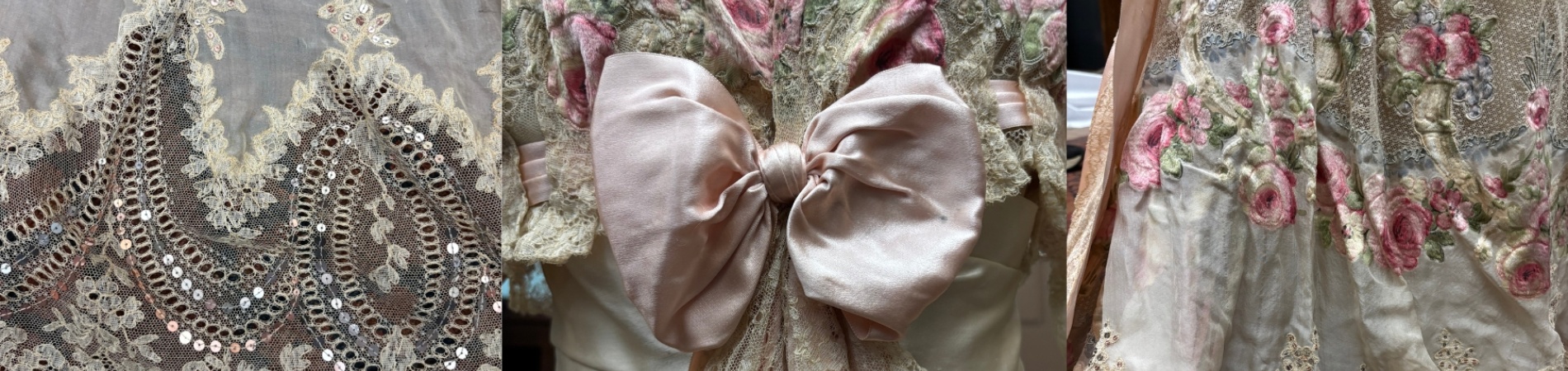
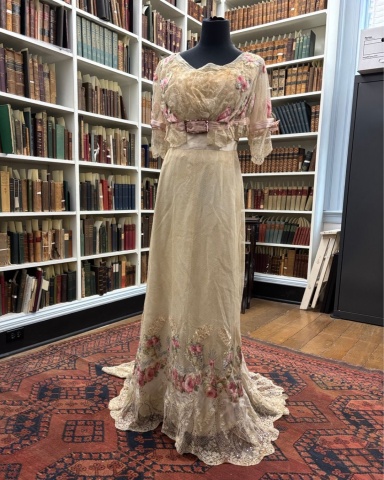
Out of the many dresses in Liberty Hall’s collection, there is none more intriguing than this cream chiffon and lace evening gown. Around the waist there is a pink satin sash with a pink sequin buckle at the front and a bow at the back. The ends of the bow trail down the back of the skirt and grace the hem. The sleeves feature the same pink satin ribbon around the arm bands. The bodice and skirt are embellished with sequins and painted velvet rose appliques.
From the inside of the dress, you can tell that it has been well worn, mended, and altered to suit changing fashions—all of which are common features of historic gowns. The thing that makes this gown special is a signature from the designer hidden away on the internal waistband. C. Worth.
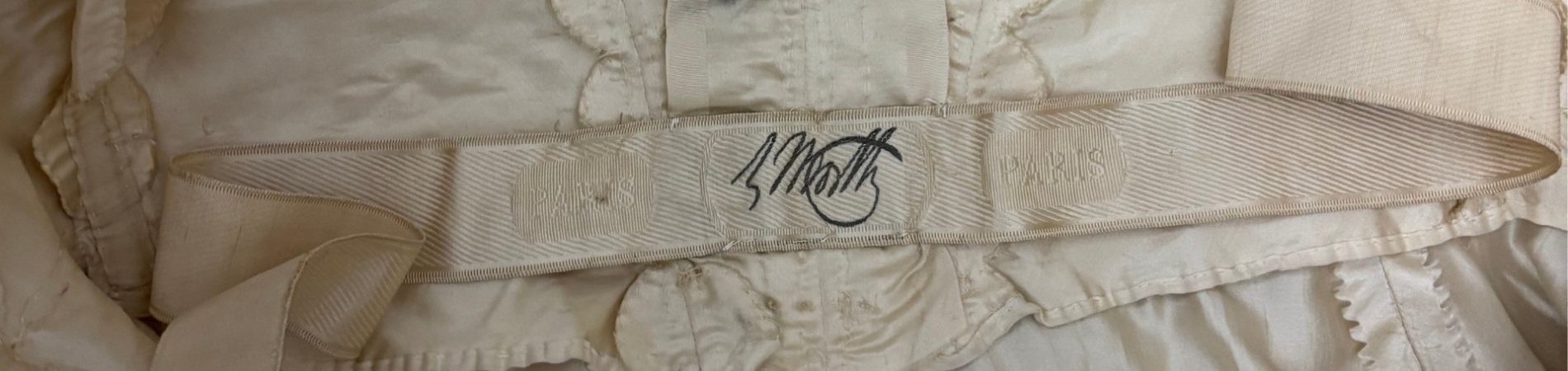
Charles Frederick Worth and the Parisian fashion house he founded became known as the father of haute couture, paving the way for luxury fashion brands of today. The House of Worth created custom gowns for Empress Eugenie of France, Empress Elisabeth of Austria, and countless theatrical and operatic stars. If you were a young lady coming of age in the 1870s, you would’ve known the name Charles Frederick Worth. His designs—and their copycats—were plastered in department store windows and printed in ladies’ magazines.
It would be surprising if John Brown’s granddaughters and great-granddaughters had never heard of The House of Worth. It’s even more surprising that they would have owned one of these coveted gowns. But one of them did. It is unclear which Brown descendant purchased the dress, but it’s likely that it was Lilian Mason Brown or Mary Yoder Brown Scott. In the summer of 1908, the two take a tour of Europe together, and it’s likely the Worth gown was purchased then.
The pair traveled mostly in Italy and Southern France, then later spent some time in Germany, Belgium, and England. They notably skipped over Paris— the home of The House of Worth. How did Lillian or Mary buy this gown then?
While Worth is most known as a Parisian brand, they were actually a global affair. In addition to the primary location in Paris, they had locations in Cannes and London, with luxury department stores in major cities carrying the brand as well. Lillian and Mary visited both Cannes and London and could’ve gotten the dress in either place.
In her letters from the trip, Mary Yoder Brown mentions shopping a few times but never anything about a Worth gown. We don’t have any letters from Lillian, so it’s unclear what her shopping habits during the trip were. But they both would’ve needed formal gowns like this.
Lillian was deeply involved in the St. Louis art scene. She was a working artist and a member of the St. Louis Artists Guild, even holding the title of president for a while. She was frequently exhibited in St. Louis and across the U.S. The formal events she would’ve likely attended as an artist were just the types of places to see stylish evening wear like the gowns Worth designed. As a Frankfort socialite and active member of the community, Mary would’ve likely attended similar formal events.
Whoever bought the dress originally, they loved it, taking the time and money to have it altered into a different style in the 1910s. The waistband was raised and expanded, the sleeves were redesigned, and panels in the skirt were removed. These changes reflect what we see today.
The gown featured in this post will be on display at our Bourbon and Brown’s VIP exhibit: Dressed to the Nines.
References
English, Bonnie, and Nazanin Hedayat Munroe. A Cultural History of Western Fashion: From Haute Couture to Virtual Couture. London: Bloomsbury Visual Arts, 2022. 13-17, 53-57.
“Lillian Mason Brown.” Missouri Remembers: Artists in Missouri through 1951. Date accessed February 25, 2026. https://missouriartists.org/person/morem109/.
N.A. A History of Feminine Fashion. London: Ed J. Burrow & Co, 1920. https://archive.org/details/AHistoryOfFeminineFashion.